My bloodwork said “normal.” My calendar said otherwise.
The RSVP sat on the fridge for three weeks. My cousin’s wedding was in June, a Saturday, circled in the group chat by everyone except me. “Just say yes,” my sister texted. I typed yes, deleted it, and typed probably. My cycle wouldn’t settle into a pattern, and I was tired before the day started. By the time the kettle clicked, the walk to the mailbox already felt like too much.
It wasn’t that I didn’t want to go. It was that I had stopped trusting any date that needed my body to cooperate, and I had stopped trusting my energy to last. Afternoons went flat. A short errand left me emptied out, and I still could not say when the next cycle would show up. I had a folder in the hall drawer of lab printouts, each one marked within reference range. Normal, the page said. Normal hadn’t told me when anything would happen.

A window, not an answer
The numbers were something to discuss with my doctor. They did not make my tired afternoons or unpredictable cycle easier to plan around. I could tell you the numbers were fine. I could not tell you whether June was a month I could promise.
The page said fine, and the calendar stayed blank. Friends heard “normal” and relaxed. I was still the one who had to answer the group chat. Nothing in the window told me what a Tuesday morning was for. I did not need a new label on the folder. I needed one habit I would actually keep when the week got loud.
What I had already tried
I had already done the reasonable things, in the order a tired person does them. A tracking app I opened in a parking lot and then ignored for nine days. Cutting things out of dinner until dinner was a negotiation with myself. A powder I measured with a scoop that lived in the tin. A shelf of single bottles I had bought one at a time, each one its own decision. Another appointment. Another page for the drawer that stuck in August.
The powder clumped when the kitchen was humid. The app congratulated me for logging a day and stayed quiet about the days I didn’t. The bottles did not so much share a shelf as occupy one, labels facing whichever way they had landed. The one I still opened was the one I could see from the kettle.
Why none of it stuck
The routine failed on the loud weeks, which were most weeks. The scoop stayed in the tin. A bottle I had meant to take to my sister’s stayed in a toiletry bag until the bag was unpacked for a different trip. I was not short on intentions. I was short on a morning that did not ask me to rebuild it.
What I had read, late, on a night I could not sleep, was not a shopping list. In blood plasma, myo-inositol and D-chiro-inositol sit near 40 to 1. I had been keeping habits that did not know about each other. The friction was the number of lids. The thing I had learned was that those two are discussed as a pair.
The ratio, said plainly
The idea is the pairing. Myo-inositol and D-chiro-inositol, near 40 to 1 in plasma, taken as that split rather than as one of them on its own.
1 Nordio, Basciani, and Camajani compared several ratios of the pair, including 40:1. European Review for Medical and Pharmacological Sciences. 2019;23(12):5512–5521. Their dose was 2 grams of the pair, twice a day. A daily serving built on the same split is a different dose from that study.
“I kept thinking there would be a next step. Somebody would look at the numbers and say here’s what to do on a Tuesday morning. Nobody did.”
Then I found one bottle
That pairing is what Ovamora puts in one daily serving: 2,000 mg myo-inositol and 50 mg D-chiro-inositol, in a daily serving of four capsules. Each 120-capsule bottle lasts 30 days. Myo-inositol supports ovarian function.* D-chiro-inositol supports glucose metabolism already within a normal range.*
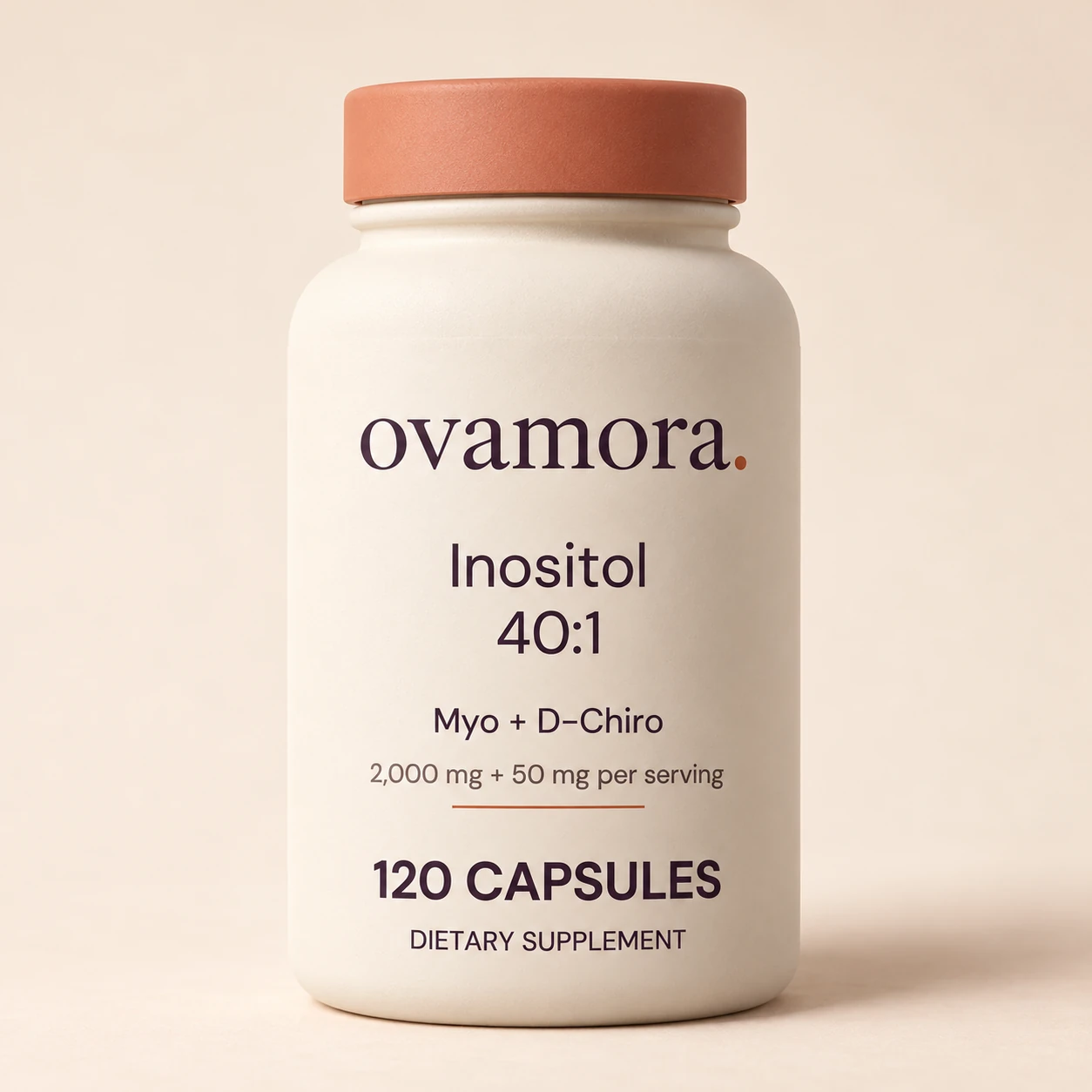
I did not find it in the folder. I found it on a morning when I was done planning routines I would forget by the next day. The drawer stayed in the hall. The bottle moved to the counter I already used.
The kettle, the next morning
What changed was the morning, not June. I put that bottle by the kettle, where the water already went on. I still missed a day. The next morning there was nothing to reassemble: no scoop to wash, no second lid in a bag I had already zipped.
On the weeks I traveled, I put that one bottle in the bag and left the shelf at home. The habit survived a loud week because it no longer had a setup cost. A place. A morning. The same serving the next day if I missed one.
If you are pregnant, trying to conceive, nursing, or taking medication, including metformin, talk with your doctor before you start.
A closer look at the bottle
See what’s in Ovamora’s 40:1 formula, how to take it, and the bottle options.
See Ovamora bottle options*These statements have not been evaluated by the Food and Drug Administration. This product is not intended to diagnose, treat, cure, or prevent any disease.